The Chasseurs Volontaires de Saint-Domingue
Afro-Caribbean regiment of free people of colour at the Siege of Savannah (1779)
Anticipating the possible resumption of conflict with Great Britain, the Count de Boynes, Secretary of State for the Navy, reorganized the French military presence in the colonies. In the Antilles, by the ordinance of King Louis XV of 18 August 1772, four colonial infantry regiments were established as permanent garrisons. These were the regiments of Martinique, Guadeloupe, Cap Français and Port au Prince.
From 1775, maritime convoys brought substantial reinforcements to the colonial garrisons with regiments from France. More than 50,000 men were sent to the Antilles during the American War of Independence from 1778 to 1783.
Local Recruitment
Experiments in recruiting from local populations were also conducted. Bouillé’s volunteers in Martinique were drawn from former soldiers or adventurous young men. The grenadiers of Martinique, “Whites,” and the chasseurs, “Free men,” were men subject to the militia who agreed to serve for the duration of the conflict in the regular army.
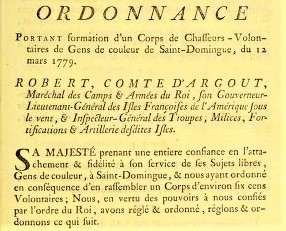
The same type of recruitment was carried out in Saint-Domingue (present-day Haiti), and thus by two ordinances dated 12 March 1779, the Governor General of Saint-Domingue, the Count d’Argout, created on one hand the Grenadier Volunteers corps, with white soldiers who had preferably served in the army, and on the other hand the Chasseurs-Volontaires de Saint-Domingue corps, marking “the full confidence [of King Louis XVI] in his Free subjects, People of colour.”
Initially composed of a battalion of ten companies of 79 men, these numbers were raised to 103 men by a new ordinance of 21 April 1779. The actual strength was around 600 soldiers in total.
Officers and Soldiers
Command of this regiment was entrusted to Colonel Laurent François Lenoir de Rouvray, and the battalion was led by Lieutenant-Colonel Alexandre Lepère de Champigny. The position of major was held by Sieur de Bussy de Blaive.
Among the officers were Lieutenant Laurent Duclos de Foncelier, who was wounded by a bullet in the shoulder at Savannah, Chevalier Henri de Forestier, second captain, Captain Jean Renateau, Lieutenant Jean Baptiste Viénot de Vaublanc, and Captain Antoine Aubert du Petit-Thouars, who commanded a company at Savannah. Among the “free” soldiers were André Rigaud, Henry Christophe, a 12-year-old drummer, and Jean Baptiste Chavannes.
The Uniform
The uniform of the Chasseurs-Volontaires was initially a blue cloth coat lined with quarter-washed linen, with blue cloth collars and yellow cloth cuffs — which later became green, with the collar turning yellow — small white buttons, slanted pockets, green cloth epaulettes, quarter-washed white linen breeches, a plain hat adorned with a white and yellow feather, and white linen gaiters.
 | 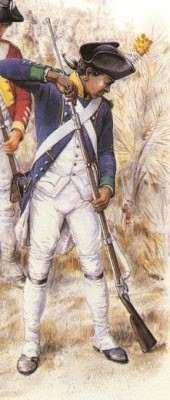 |
| Uniform of the Chasseurs Volontaires | Soldier of the Chasseurs Volontaires |
The Siege of Savannah
On 15 August 1779, the regiment embarked at Cap Français with the expeditionary corps commanded by the Count d’Estaing. It landed in Georgia on 8 September 1779 to lay siege to the city of Savannah, held by the British. The Chasseurs Volontaires received their baptism of fire there and conducted themselves very honourably during the operations, which lasted until 18 October, when the siege had to be lifted. Many officers and soldiers of the regiment were killed or wounded.
The regiment was dissolved in 1780 by the successor of the Count d’Argout, Jean-François Reynaud de Villeverd, the new Governor General of Saint-Domingue, and a corps was reformed by an Ordinance of 12 May 1780 under the name “Chasseurs Royaux,” reduced from 10 companies to 5, under the command of a lieutenant-colonel.
The Savannah Monument
On 11 October 2009, a monument was inaugurated at Franklin Square in Savannah, the work of James Mastin, erected in memory of the Chasseurs Volontaires de Saint-Domingue regiment. On a granite base, six statues — five soldiers, one of whom is wounded, and a sixth representing the company drummer — commemorate the participation of this regiment of Afro-Caribbean soldiers in the American War of Independence.
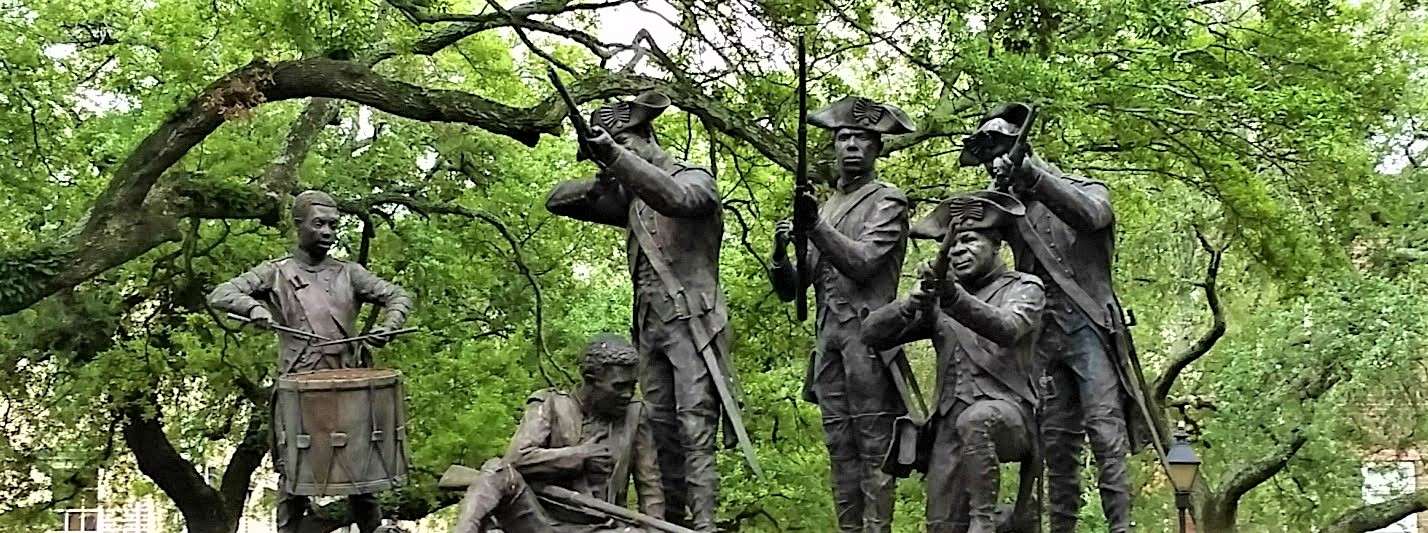
Monument to the Chasseurs Volontaires de Saint-Domingue in Savannah, Franklin Square
The largest unit of soldiers of African descent who fought in the American revolution was the brave « Les Chasseurs volontaires de Saint Domingue » from Haiti. This regiment consisted of free men who volunteered for a campaign to capture Savannah from the British in 1779. Their sacrifice reminds us that men of African descent were also present on many other battlefields during the revolution.
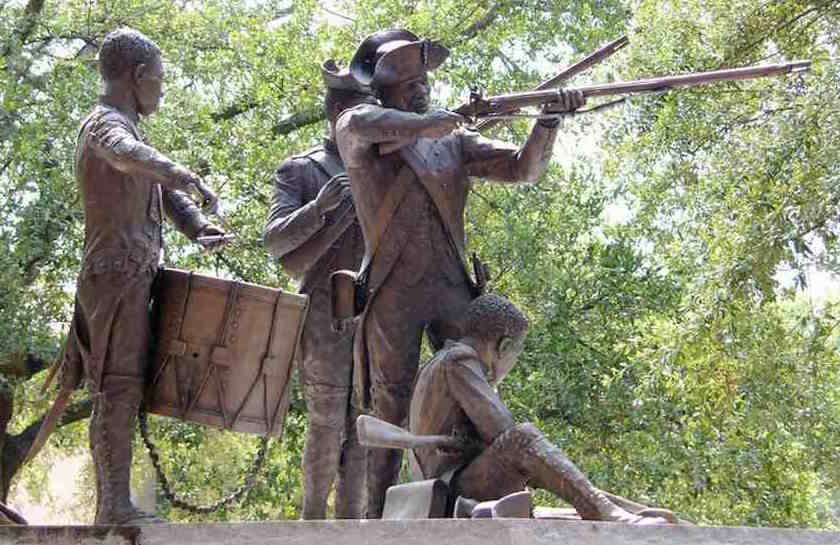
Commemorative plaque of the Savannah monument
Notable Destinies
André Rigaud — A mixed-race goldsmith by trade, André Rigaud enlisted as a quartermaster in 1779 in the Chasseurs volontaires de Saint-Domingue at their creation. He was wounded twice, first at Savannah, then on the Annibal. A militia officer in 1790, he was appointed lieutenant-colonel in May 1793 when he raised troops in the western part. Commander-in-chief of the army sent by the civil commissioners against the rebels of Jérémie in June 1793, then colonel of the Equality Legion of the South, and provisional commander of the Province with the rank of colonel, he became military commander of the southern part on 26 November 1793. He was rewarded for his unquestionable loyalty to the Republic on 23 July 1795 with the rank of brigadier general.
Henry Christophe — A freed slave who at the age of 12 was a drummer at Savannah, he distinguished himself during the Haitian revolution by fighting alongside Toussaint Louverture against the French. He became King of Haiti from 1811 to 1820, under the name Henry I.
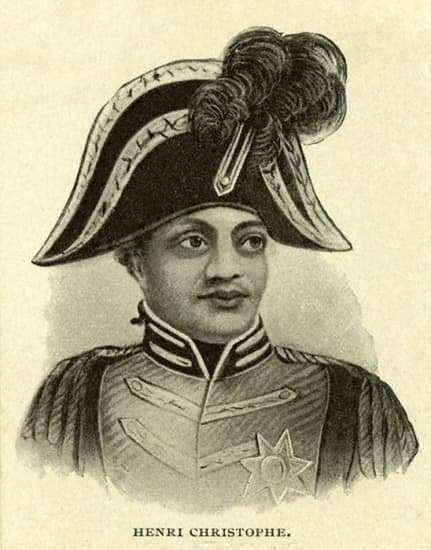
Henry I, King of Haiti
Jean Baptiste Chavannes — In 1790, Jean Baptiste Chavannes supported the action of Vincent Ogé in Saint-Domingue to obtain equal rights between whites and free people of colour. The revolt having failed, the mutineers were handed over to the French authorities by the Spanish. Condemned to the breaking wheel and executed on 25 February 1791, their struggle undoubtedly inspired the uprising of black slaves in 1791.
References
- L'Alliance franco-Américaine, Bulletin de la Société en France des Fils de la Révolution Américaine, N° 38 et 39, année 2019
- Le soldat de couleur dans la société d'Ancien Régime et durant la période révolutionnaire, Boris Lesueur — https://www.editions-karthala.com/
- Les troupes royales aux colonies (1664-1792), Généalogie et Histoire de la Caraïbe, n° 228, Septembre 2009
- Les Nègres d'Haïti dans la guerre d'Indépendance américaine, Docteur Clément Lanier